How much does room automation save a hotel?
Where the savings come from, what published studies measure, and how to estimate the rupee figure for your own property.
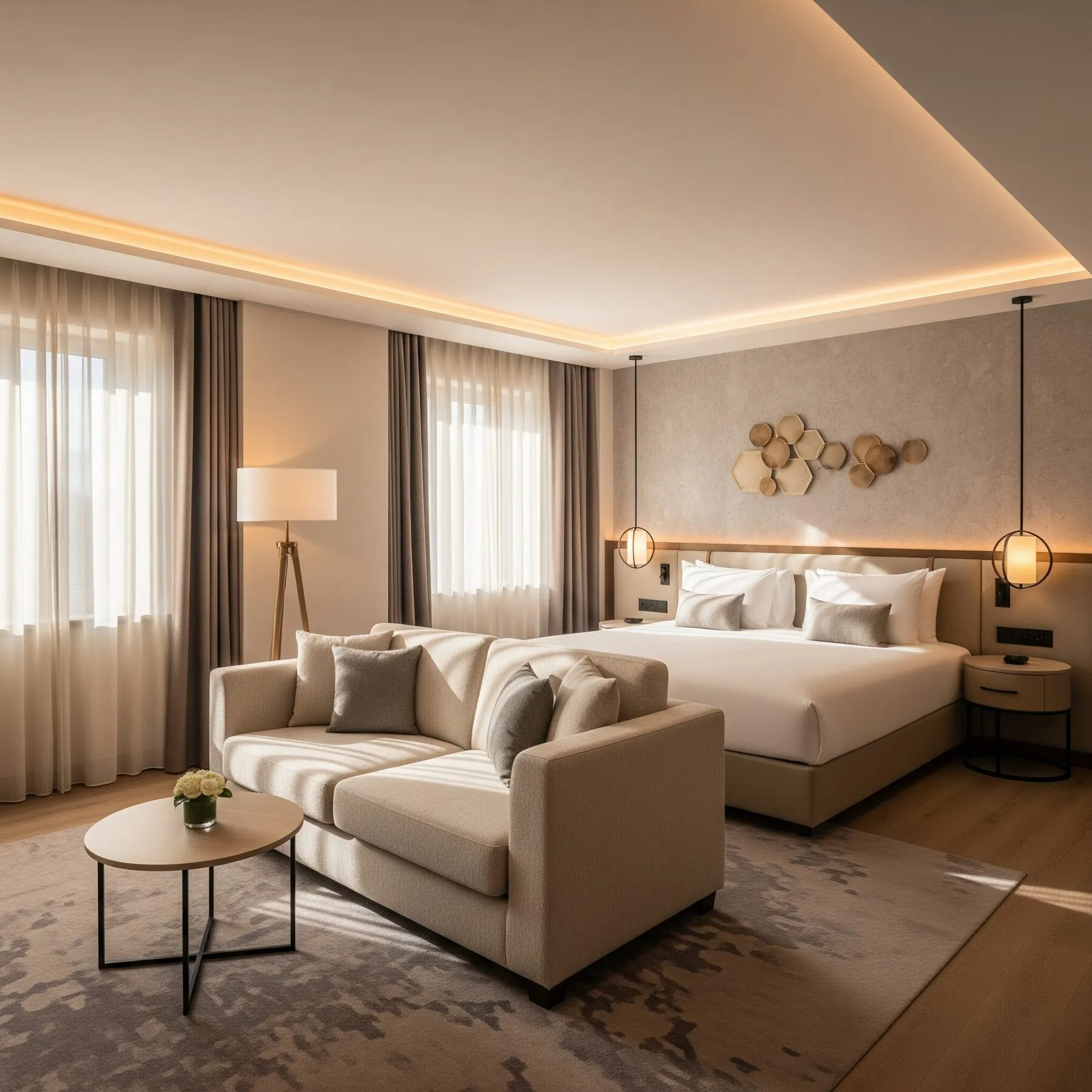
Most of the electricity a hotel room uses goes into cooling it. In India, where rooms are cooled for most of the year, that makes the guest room the single biggest place to save energy, and the place where most of it is wasted.
Where the waste is
A room is cooled whether or not anyone is in it. Three situations account for most of the waste:
- Unsold rooms. A room that is not sold tonight is often still cooled, either because nobody switched it off or because it is kept “ready”.
- Guests who step out. A guest leaves for a meeting or dinner and the AC keeps running at 21 °C for hours. A business card left in the key card slot keeps everything on.
- Open balcony doors and windows. Cooling a room with the door open costs more and cools nothing.
What room control does about it
A guest room management system (GRMS) knows the state of every room: sold or unsold, guest in or out, door open or closed. It uses that to:
- Hold unsold rooms in a low-energy mode, set automatically from the property management system at check-out.
- Ease the temperature back when the key card leaves the slot or the occupancy sensor sees an empty room, and bring it back when the guest returns.
- Pause the AC while a balcony door is open.
What the research measures
Published results vary with climate, how far the temperature is set back, and how rooms are used:
- A nationwide simulation of large hotels across 19 climate zones found 24% to 58% savings in HVAC energy from occupant-centric controls (Pang et al., Journal of Building Performance Simulation, 2021).
- A study using a year of measured data from hotel guest rooms found about 29% savings in heating and cooling energy (Kim and Oldham, ASHRAE, 2019).
- At the Washington Hilton, a networked guest room energy management system used 41% less HVAC energy than standalone room thermostats over six months, in a study validated by the local energy utility.
Savings are largest where cooling runs for many hours a year, which describes most of India.
Turning it into rupees
For your hotel the saving depends on five things: the number of rooms, average occupancy, the size of the room AC, how many hours a day rooms are cooled in your climate, and what you pay per unit of electricity.
Our energy savings estimator works it out from those inputs. It deliberately uses the low end of the research, 25% of cooling energy in occupied rooms, plus the saving from unsold-room mode, and shows a range rather than a single number.
As an example, a 120-room hotel in a city with hot summers, at 65% occupancy and ₹9 per unit, comes to roughly ₹15 lakh a year, or about ₹12,700 per room.
Getting a measured figure
An estimate is a starting point. For a figure you can take to an owner or a board, we look at your electricity bills, room types and occupancy, and survey the property. Book a demo and we will walk you through it.