Key card switch or occupancy sensor? What a hotel room needs
How key card energy savers and occupancy sensors each decide a room is empty, where each one fails, and why most hotels use both.
Every room automation system has to answer one question many times a day: is anyone in this room? The answer decides whether the air conditioning keeps running and the lights stay on. Hotels answer it in two ways, with a key card switch by the door or with sensors that look for people. They are often sold as alternatives. They are better thought of as partners.
How a key card switch works
The key card switch is the slot by the door. The guest puts the room card in and the room wakes up: lights, AC and sockets come on. The guest takes the card out when leaving and, after a short delay, the room powers down.
It is simple, cheap, and every guest understands it. It also has one well-known weakness: the slot cannot tell a guest’s card from any other piece of plastic. Guests who want the AC running while they are out leave a business card, a loyalty card or the second room key in the slot. The room then stays fully on all day.
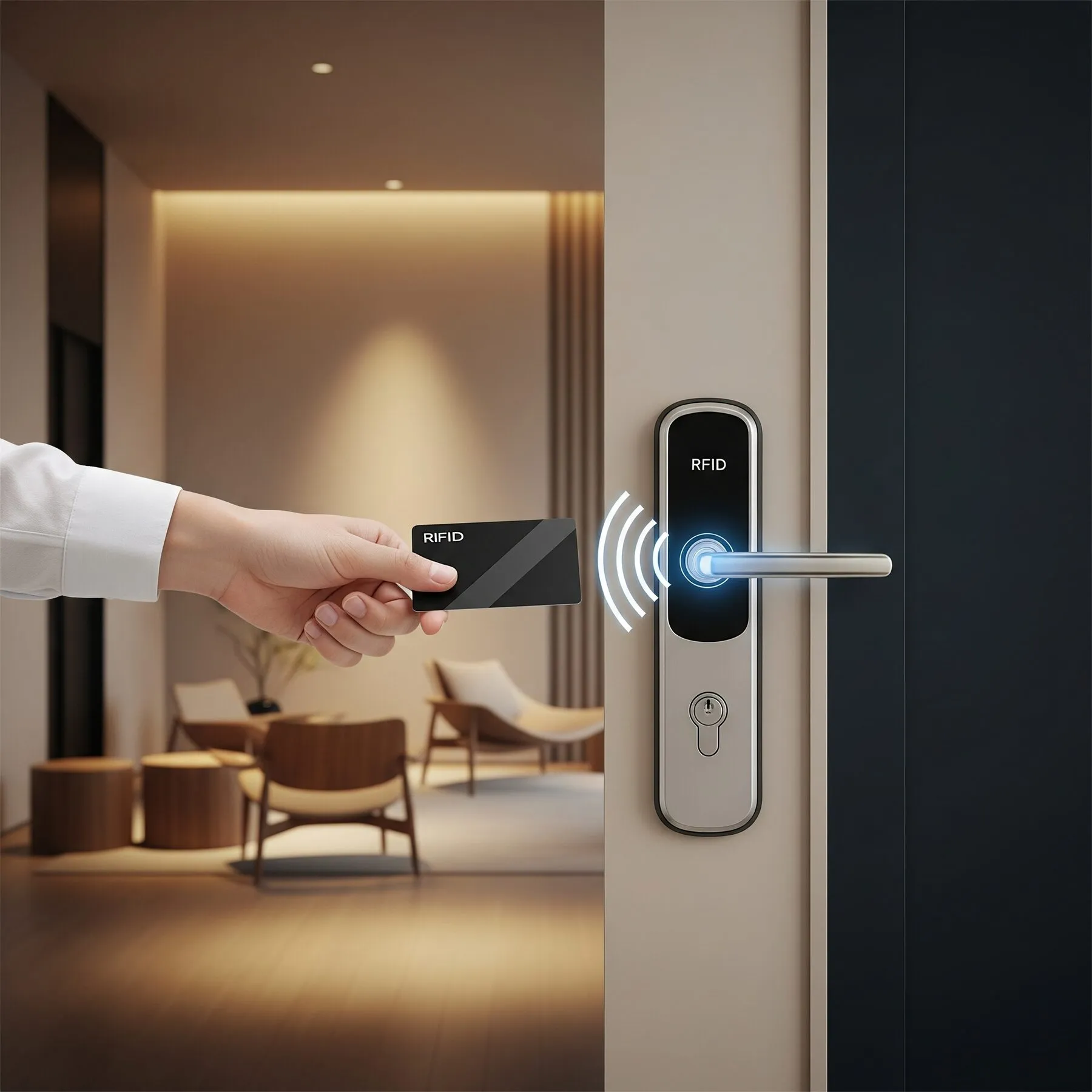
RFID energy savers close most of that gap. They read the card, so only a valid card for that room (or a staff card) switches it on. A guest can still leave their second key behind, but an old card from another hotel will not work. The same RFID card can also open the door and call the lift. See RFID applications.
How occupancy sensing works
Occupancy sensors look for people instead of cards. Most hotel rooms combine two:
- A ceiling sensor (passive infrared, microwave, or both) that detects movement.
- A door contact that knows when the entrance door opens and closes.
Together they answer the question properly. If the door closed and the sensor then saw movement, someone is inside, even if they are lying still asleep. If the door opened and closed and the room has been still since, it is empty. A business card in the slot does not change that.
Sensors on their own have their own failure: a guest reading or sleeping very still can look like an empty room to a ceiling sensor alone. That is why the door contact matters. Once the room knows someone came in and nobody has left, it does not switch off on a quiet sensor.
Why most hotels use both
Used together, each covers the other’s weakness:
- The card says who. It wakes the room, tells the system it is a guest and not housekeeping, and gives the guest a familiar way to switch everything off.
- The sensors say whether. They catch the card left in the slot, and they let the room ease the AC back when a guest has stepped out for a few hours without taking the card.
The room controller combines both signals with the booking status from the property management system. A sold room with the guest out can be eased back a few degrees and brought back before they return. An unsold room can sit in a deep energy-saving mode until check-in.
Things to decide before you buy
- What stays on when the card is out. Most hotels keep one socket live for phone and laptop charging, and the minibar fridge on its own supply.
- How long the delay is. Long enough for a guest to step into the corridor for ice, short enough not to cool an empty room for an hour.
- What “eased back” means. A few degrees warmer, not off, so the room is comfortable again within minutes.
- Retrofit or new build. In an operating hotel, wireless sensors and a wireless retrofit kit avoid opening the walls.
The short answer
A key card switch alone is the minimum. An RFID energy saver closes the business-card loophole. Occupancy sensing with a door contact is what lets a room save energy while staying comfortable for the guest who is actually there. To see what that is worth for your property in rupees, try the savings estimator, or ask us to survey a room.